
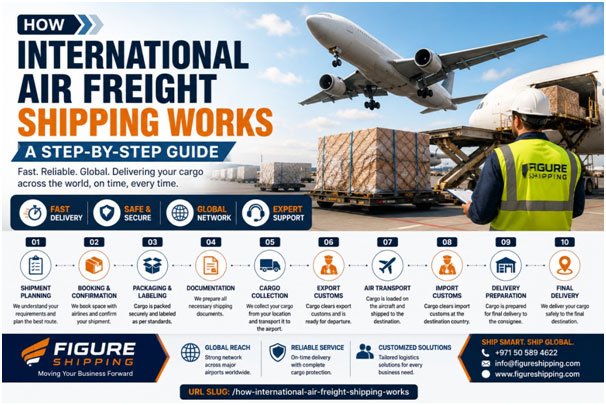
International trade depends on reliable logistics solutions to move goods quickly and safely across borders. Among the available transportation methods, international air freight shipping is the preferred choice for businesses that require fast delivery, high security, and dependable transit schedules. Whether transporting electronics, pharmaceuticals, automotive parts, fashion products, or urgent commercial cargo, air freight helps businesses reach global markets efficiently.
Although the process may appear complex, international air freight follows a well-organized sequence of steps involving freight forwarders, airlines, customs authorities, warehouses, and delivery partners. Understanding this process helps businesses plan shipments, reduce delays, and improve supply chain performance.
This guide explains how international air freight shipping works, from booking a shipment to final delivery.
International air freight shipping is the transportation of goods between countries using commercial or cargo aircraft. It is widely used for shipments that require faster delivery than sea or road transportation.
Air freight is commonly selected for:
Although air freight generally costs more than sea freight, the reduced transit time often makes it the preferred option for urgent shipments.
Every successful shipment begins with careful planning.
Before booking cargo, businesses determine:
Proper planning helps avoid delays and ensures the shipment meets airline and customs requirements.
A freight forwarder manages the transportation process on behalf of the customer.
Their responsibilities typically include:
Working with an experienced freight forwarding company simplifies international shipping and minimizes administrative challenges.
Proper packaging protects cargo during transportation.
Packaging should:
Sensitive products may require specialized packaging, including temperature-controlled or shock-resistant materials.
Correct labeling is equally important to ensure accurate cargo handling.
International air freight requires several documents before cargo can leave the origin country.
Air Waybill (AWB)
The Air Waybill serves as the primary shipping document and contains shipment details, consignee information, and routing instructions.
Commercial Invoice
This document describes the goods, their value, and transaction details for customs authorities.
Packing List
The packing list provides detailed information about package contents, dimensions, and weights.
Certificates and Permits
Certain products may require:
Accurate documentation reduces customs delays.
Once documentation is complete, the cargo is collected from the shipper’s warehouse or manufacturing facility.
Many freight companies provide:
The shipment is then transported to the cargo terminal at the departure airport.
Before leaving the country, cargo must complete export customs procedures.
Customs authorities verify:
After approval, the cargo is cleared for export and transferred to the airline.
At the airport cargo terminal, the shipment undergoes several procedures.
These include:
Security Screening
Cargo is inspected using approved screening methods to comply with international aviation security standards.
Cargo Consolidation
Smaller shipments may be combined with other cargo destined for similar locations to optimize aircraft capacity.
Loading
Cargo handlers load shipments onto aircraft according to airline safety procedures and weight distribution requirements.
The shipment is transported to its destination using scheduled cargo or passenger aircraft carrying freight.
Transit times vary depending on:
Compared to sea freight, air transportation significantly reduces delivery times.
After arrival, customs officials inspect the shipment before releasing it for delivery.
Import customs typically review:
Once customs requirements are completed, the shipment is released.
After customs clearance, cargo moves to the consignee through local transportation.
Delivery options include:
Many logistics providers offer real-time shipment tracking until final delivery is completed.
Businesses choose air freight for several important reasons.
Air freight offers the shortest transit times for international shipments.
Airlines operate on scheduled departure and arrival times, improving shipment predictability.
Airport cargo terminals follow strict security procedures throughout transportation.
Air freight provides access to thousands of international destinations through extensive airline networks.
Shorter delivery times help businesses maintain lower inventory levels and improve supply chain efficiency.
International air freight supports numerous industries.
These include:
Each industry benefits from faster delivery and reliable transportation.
Figure Shipping provides comprehensive international logistics solutions for businesses requiring fast, secure, and efficient cargo transportation.
Services include:
With experienced logistics professionals, global transportation networks, and customer-focused service, Figure Shipping helps businesses move cargo efficiently across international markets.
International air freight shipping is one of the fastest and most reliable methods for transporting goods worldwide. From shipment planning and documentation to customs clearance and final delivery, every stage follows a structured process designed to ensure safe, efficient transportation.
By understanding how international air freight works and partnering with an experienced logistics provider like Figure Shipping, businesses can reduce shipping delays, improve supply chain performance, and confidently expand into global markets.
International air freight shipping is the transportation of goods between countries using commercial or cargo aircraft for fast and secure delivery.
Common documents include the Air Waybill (AWB), commercial invoice, packing list, certificates of origin, and any required export or import permits.
Transit times vary by destination and airline schedules, but air freight is generally much faster than sea freight for international shipments.
Air freight is ideal for electronics, pharmaceuticals, automotive parts, medical equipment, fashion products, high-value goods, and time-sensitive commercial cargo.
Businesses benefit from faster delivery, improved shipment security, reliable schedules, global connectivity, and better supply chain efficiency.


Figure Shipping
©2026. All Rights Reserved.


